
Section 179 for Automotive Shop Equipment: How to Write Off Your 2026 Equipment Purchases
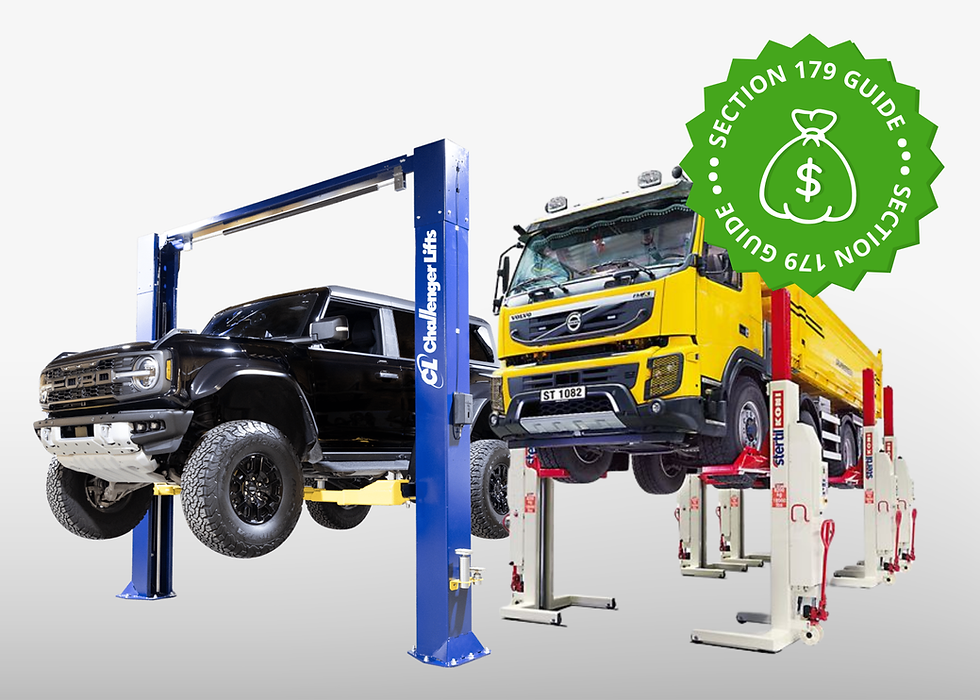
Quick answer: Section 179 of the IRS tax code lets businesses deduct the full purchase price of qualifying equipment in the year it's placed in service, instead of depreciating it over five to seven years. For 2026, auto repair shops, dealerships, and fleet maintenance facilities can deduct up to $2,560,000 in qualifying equipment, including vehicle lifts, alignment systems, tire changers, wheel balancers, and air compressors, as long as the equipment is purchased or financed and in use by December 31, 2026.
What Is Section 179?
Normally, when a business buys equipment, it recovers the cost slowly through depreciation, a few thousand dollars a year over the equipment's useful life. Section 179 changes that timeline. It allows you to elect to deduct the entire cost up front, in the same tax year you put the equipment to work.
For shop owners, that means a $60,000 alignment system doesn't have to be a seven-year write-off. It can reduce this year's taxable income by the full $60,000.
2026 Section 179 Limits at a Glance
Item | 2026 Amount |
Maximum Section 179 deduction | $2,560,000 |
Phase-out begins | $4,090,000 in total equipment purchases |
Deduction fully eliminated | $6,650,000 in total equipment purchases |
Bonus depreciation | 100% (made permanent in 2025) |
Deadline | Equipment must be placed in service by Dec. 31, 2026 |
The 2026 limit is more than double what it was just two years ago, thanks to the One Big Beautiful Bill Act signed in July 2025. For the vast majority of independent shops, the cap is effectively unlimited, since few will spend over $4 million on equipment in a single year.
What Automotive Equipment Qualifies?
Section 179 applies to tangible business equipment, new or used, that's used more than 50% for business purposes. In an automotive shop, that typically includes:
Vehicle lifts: two-post, four-post, scissor, mobile column, and alignment lifts
Wheel service equipment: tire changers, wheel balancers, and tire storage systems
Alignment systems: wheel aligners and alignment racks
Air systems: air compressors, dryers, and air line components
Diagnostic equipment: scan tools, ADAS calibration systems, and testing equipment
Fluid and exhaust management: fluid exchangers, oil drains, and exhaust extraction systems
Shop furnishings: tool storage, workbenches, and service carts
Off-the-shelf shop software: commercially available management and diagnostic software
Used equipment qualifies too, as long as it's new to your business. One caution: some in-ground or permanently installed equipment may be treated as part of the building rather than as equipment. If you're planning an in-ground lift installation or a facility buildout, confirm the treatment with your tax professional before you buy.
5 Benefits of Section 179 for Auto Shops
Immediate tax savings. The biggest benefit is simple: you lower this year's tax bill instead of waiting years to recover your investment. That cash stays in your business, where it can go toward payroll, inventory, or your next equipment upgrade.
Financed equipment qualifies for the full deduction. You don't have to pay cash to take the full deduction. Equipment purchased through a loan or an equipment finance agreement (including a $1 buyout lease) can qualify for the full Section 179 deduction in year one, even though you're paying it off over time. In many cases, the first-year tax savings exceed what you pay in financing during that year.
Faster return on investment. New equipment already pays for itself through more bays in use, faster turnaround, and work you no longer have to send out. Section 179 shortens the payback period further by cutting your effective cost up front.
A competitive edge in technician recruiting. Technicians want to work in shops with modern, safe, well-maintained equipment. Upgrading lifts and service equipment supports recruiting and retention, and Section 179 makes that upgrade easier to justify this year.
Easier planning for fleets and multi-location operators. For fleet maintenance facilities and multi-location groups, the higher 2026 limit means larger equipment rollouts can be expensed in a single year. Bonus depreciation can pick up anything above the Section 179 limit.
Example: What Section 179 Could Save Your Shop
Say your shop buys and installs the following in November 2026:
Equipment | Cost |
Two 10,000 lb. two-post lifts | $16,000 |
One four-post alignment lift | $22,000 |
Wheel aligner | $45,000 |
Tire changer and wheel balancer | $17,000 |
Total equipment cost | $100,000 |
| Without Section 179 | With Section 179 |
First-year deduction | About $14,290 (7-year MACRS) | $100,000 |
Estimated tax savings (24% bracket) | About $3,430 | $24,000 |
Effective net cost of equipment | — | $76,000 |
Example is illustrative only. Actual savings depend on your tax bracket, business income, state tax rules, and how the purchase is structured.
Section 179 vs. Bonus Depreciation: What's the Difference?
Both let you accelerate your write-off, but they work differently:
Section 179 is an election you choose asset by asset. It's capped at $2,560,000, and it can't exceed your business's taxable income for the year, which means it can't create a loss.
Bonus depreciation applies automatically at 100% for 2026, has no dollar cap, and can create a net operating loss you carry forward.
Many businesses use both: Section 179 first, then bonus depreciation for the rest. Which combination is right for your shop depends on your income, your state's tax rules (not every state follows the federal rules), and your long-term plans. That's a conversation for your CPA.
Key Requirements and Deadlines
Placed in service by December 31, 2026. Ordering equipment isn't enough. It must be delivered, installed, and ready to use. Lift installations and inspections take time to schedule, so don't wait until December.
More than 50% business use. Equipment must be used primarily for business.
Elect it on your return. Section 179 isn't automatic. Your tax preparer claims it on IRS Form 4562.
Income limitation. The deduction can't exceed your net business income for the year, though unused amounts can be carried forward.
Plan Your 2026 Equipment Purchases Now
With 100% bonus depreciation now permanent and the Section 179 limit at its highest point ever, 2026 is an excellent year to replace aging lifts, add bays, or upgrade alignment and tire equipment. The key is timing: the year-end rush for equipment, installation, and inspection is real.
Ready to upgrade before December 31? ADG Equipment is the largest network of independent automotive equipment distributors in the U.S., with 30 member locations nationwide. Your local ADG distributor can help you choose the right lifts and shop equipment, line up financing, and get everything installed and in service before year-end.
This article is for informational purposes only and is not tax advice. Consult a qualified tax professional about your specific situation.
Frequently Asked Questions
What is the Section 179 deduction limit for 2026?
The maximum Section 179 deduction for 2026 is $2,560,000. The deduction begins to phase out dollar-for-dollar once total qualifying equipment purchases exceed $4,090,000.
Do automotive lifts qualify for Section 179?
Most vehicle lifts, including two-post, four-post, scissor, and mobile column lifts, typically qualify as business equipment. Some in-ground lifts may be treated as building improvements, so confirm with your tax professional.
Can I use Section 179 on financed or leased equipment?
Yes. Equipment purchased with a loan or an equipment finance agreement, including a $1 buyout lease, can qualify for the full deduction in the year it's placed in service. True operating leases generally do not qualify.Yes. Equipment purchased with a loan or an equipment finance agreement, including a $1 buyout lease, can qualify for the full deduction in the year it's placed in service. True operating leases generally do not qualify.
Does used shop equipment qualify for Section 179?
Yes. Used equipment qualifies as long as it's new to your business and used more than 50% for business purposes.
What is the deadline to claim Section 179 for 2026?
Equipment must be purchased or financed and placed in service (delivered, installed, and ready for use) by December 31, 2026.Equipment must be purchased or financed and placed in service (delivered, installed, and ready for use) by December 31, 2026.
Is Section 179 better than bonus depreciation?
Neither is universally better. Section 179 offers asset-by-asset flexibility but is limited to business income, while 100% bonus depreciation has no cap and can create a loss. Many businesses use both.


Comments